Body layer
Breath, posture, fatigue, tension, and energy are often the system's earliest signals.
Human-AI Operating System · After the execution layer
Frontier models behave like a working cortex: they think, see, operate, and finish. Human-AI OS is not another assistant. It is the system that holds body signals, emotion, cognitive judgment, and authorization rules in one place you can still update.
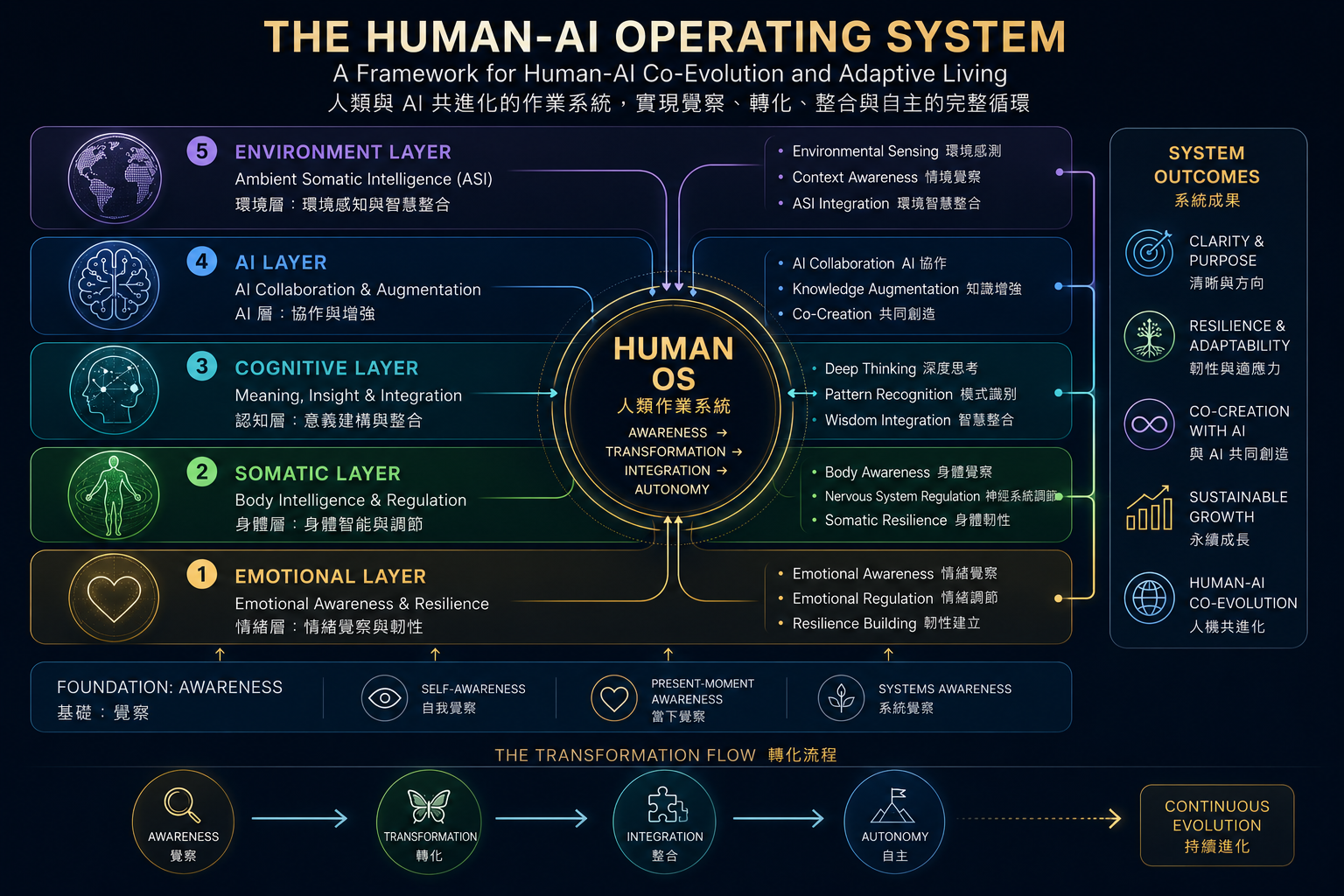
Architecture
The core of Human-AI OS is integration. The body provides sensing, emotion provides signal, cognition provides judgment, the execution layer finishes the work, and the person keeps defining the problem, setting the goal, judging the result, and owning the decision.
When these layers begin to cooperate, a person can remain clear inside information overload, keep a sense of choice under pressure, and continue creating value in a changing age.
Human OS can also be named more sharply: the ability to stop the Human Hijack Chain from closing. Before attention is taken, narrative loops, and arousal turns into reflex, the system must cut output, regulate state, and recover agency.
Four Layers
Breath, posture, fatigue, tension, and energy are often the system's earliest signals.
Anxiety, pressure, anger, emptiness, and meaning show what the person is carrying.
Judgment, attention, memory, language, and worldview shape how reality is understood.
The execution layer can draft, operate, and finish tasks. A person draws allow, review, and block — and can replay a decision when something goes wrong.
Pathway
Human-AI OS connects to three deeper accompaniment paths: Level 1 stabilizes body and emotion, Level 2 clarifies life direction and life design, and Level 3 turns lived experience, expertise, and insight into shareable, durable knowledge assets.